

Generative AI creates competitive advantage only when it is transformed into secure, scalable, and economically measurable solutions. My project portfolio was developed around this principle: connecting advanced scientific research, agentic architectures, multimodal systems, enterprise governance, and product strategy to solve high-value business challenges.
These initiatives address critical executive priorities, including revenue growth, operating-margin expansion, productivity, time-to-market, customer lifetime value, innovation capacity, risk reduction, and the creation of recurring-revenue models. They range from governed ecosystems for autonomous agents and AI-powered software engineering to scientific intelligence, hyperpersonalization, visual production, narrative orchestration, generative discovery, and knowledge commercialization.
Each project is structured not as an isolated proof of concept, but as a potential enterprise platform supported by measurable KPIs, proprietary intellectual assets, scalable architectures, and clear commercialization paths—including SaaS, enterprise licensing, APIs, managed services, vertical solutions, and performance-based contracts.
My work reflects a distinctive capability: translating complex AI research into strategic products that executives can understand, organizations can operationalize, and markets can value. By combining scientific rigor with business vision, governance, and execution discipline, I help companies move beyond experimentation and build AI capabilities capable of generating sustained growth, operational leverage, and defensible competitive advantage.
This portfolio represents my vision for the next generation of enterprise AI: technology designed not merely to automate tasks, but to create new products, business models, intellectual property, and market leadership.
Enjoy the new era of applied AI research!
A.N.D.RE (Autonomous Navigator for Discovery, Research, and Evidence): an enterprise platform for continuous scientific intelligence, strategic foresight, and AI-driven discovery
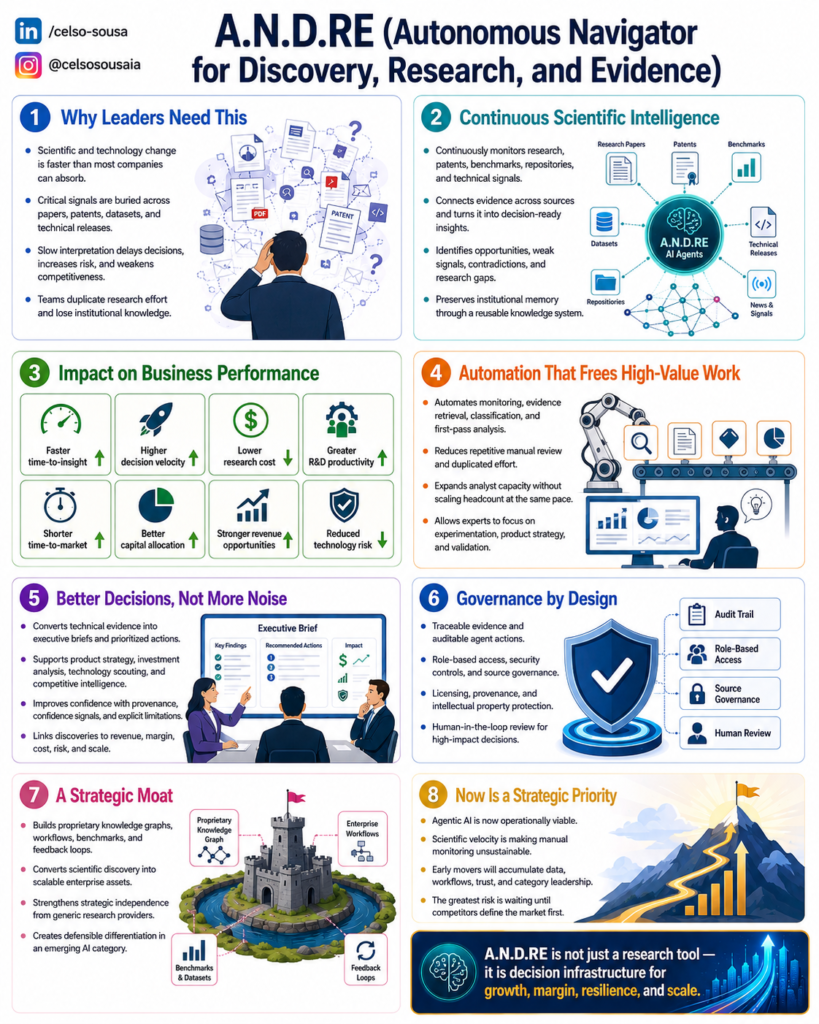
Scientific knowledge is expanding faster than most organizations can evaluate, validate, and convert into action. A.N.D.RE closes this gap through a continuous scientific intelligence platform that transforms fragmented research into prioritized, evidence-based recommendations for executives, product leaders, researchers, and investment committees.
Its business impact is measurable: reduced time-to-insight, shorter time-to-market, higher R&D productivity, lower duplicated research costs, and stronger capital allocation. Core KPIs include decision velocity, analyst capacity, innovation conversion, evidence reliability, platform adoption, costs avoided, revenue pipeline influenced, and opportunities converted into experiments, products, partnerships, or investments.
Strategically, A.N.D.RE moves enterprises from reactive research monitoring to persistent foresight. By detecting weak signals, contradictions, research gaps, and emerging technologies, it strengthens product strategy, competitive intelligence, technology scouting, investment analysis, risk anticipation, and innovation portfolio management. Its competitive moat grows through proprietary knowledge graphs, specialized research agents, validated workflows, benchmarks, enterprise integrations, and expert-feedback loops.
The commercial potential is equally significant. A.N.D.RE can generate recurring, scalable revenue through Enterprise SaaS, private-cloud and on-premises deployments, Scientific Intelligence APIs, vertical industry solutions, Research-as-a-Service, strategic foresight programs, licensing, benchmarking services, and research partnerships.
For enterprise leaders, the strategic question is how quickly they can build this capability before competitors accumulate the data, workflows, trust, and learning advantages that define category leadership.
Agentic Hyperpersonalization: multidimensional psychological intelligence for scalable AI experiences
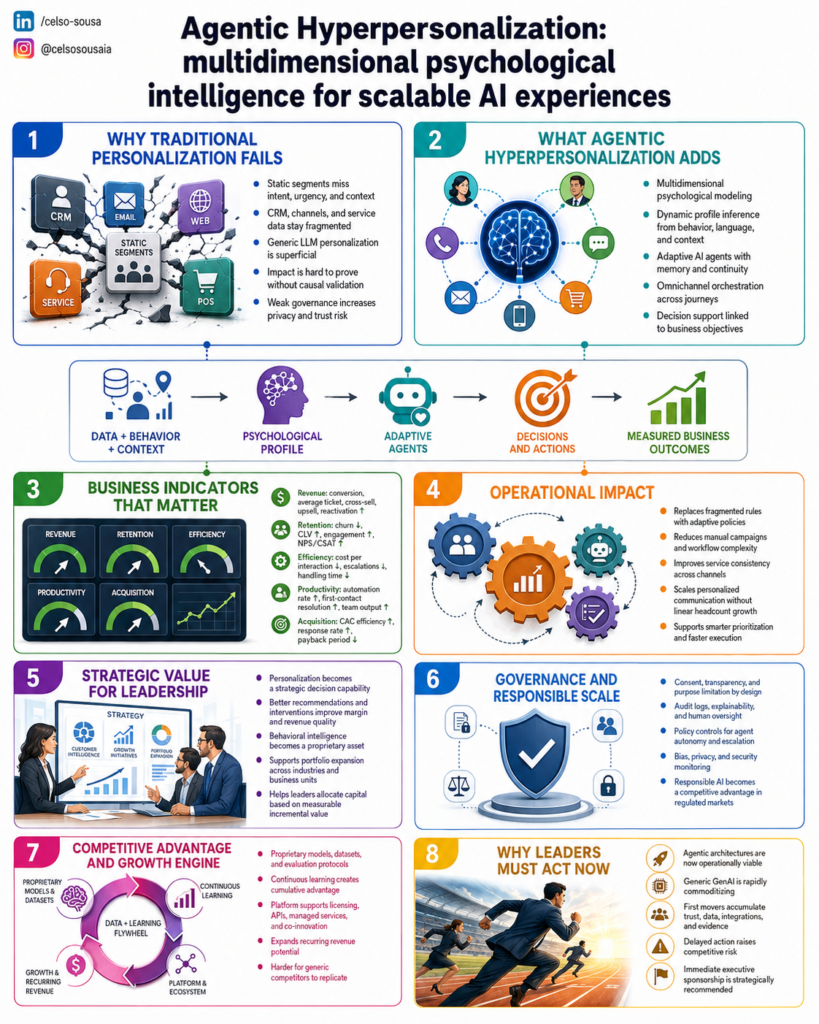
Traditional personalization is reaching its limit. Static segments, fixed journeys, and generic AI assistants may optimize isolated interactions, but they rarely explain why customers decide, how their context changes, or which action will create the greatest business value.
Agentic Hyperpersonalization introduces a new enterprise capability: AI agents that maintain dynamic behavioral profiles, adapt communication and recommendations, execute actions across channels, and learn continuously from measured outcomes. The platform combines Generative AI, behavioral science, psychometrics, contextual intelligence, and responsible governance to improve revenue, retention, customer experience, and operational efficiency.
The business case is directly connected to P&L performance. Executive KPIs include conversion uplift, incremental revenue, average ticket, cross-sell, upsell, churn, customer lifetime value, NPS, CSAT, acquisition cost, first-contact resolution, handling time, automation rate, and employee productivity. Controlled experiments ensure that investment decisions are based on causal impact rather than correlation.
Strategically, the platform creates a cumulative competitive moat. Proprietary behavioral models, datasets, experimentation frameworks, governance mechanisms, integrations, and feedback loops become increasingly valuable as adoption grows.
The commercial opportunity extends beyond a single solution. Revenue models include enterprise licensing, industry-specific platforms, managed hyperpersonalization services, behavioral intelligence APIs, co-innovation programs, premium brand and executive agents, and performance-based contracts linked to verified improvements in conversion, retention, engagement, recovery, or efficiency.
For enterprise leaders, the opportunity is to transform personalization from a marketing feature into a governed, scalable decision infrastructure.
E.N.R.I.C.O. (Enterprise Narrative Retrieval, Intelligence & Content Orchestration Engine): a scientific and commercial platform for transforming corporate knowledge into authority, influence, demand, and scalable revenue
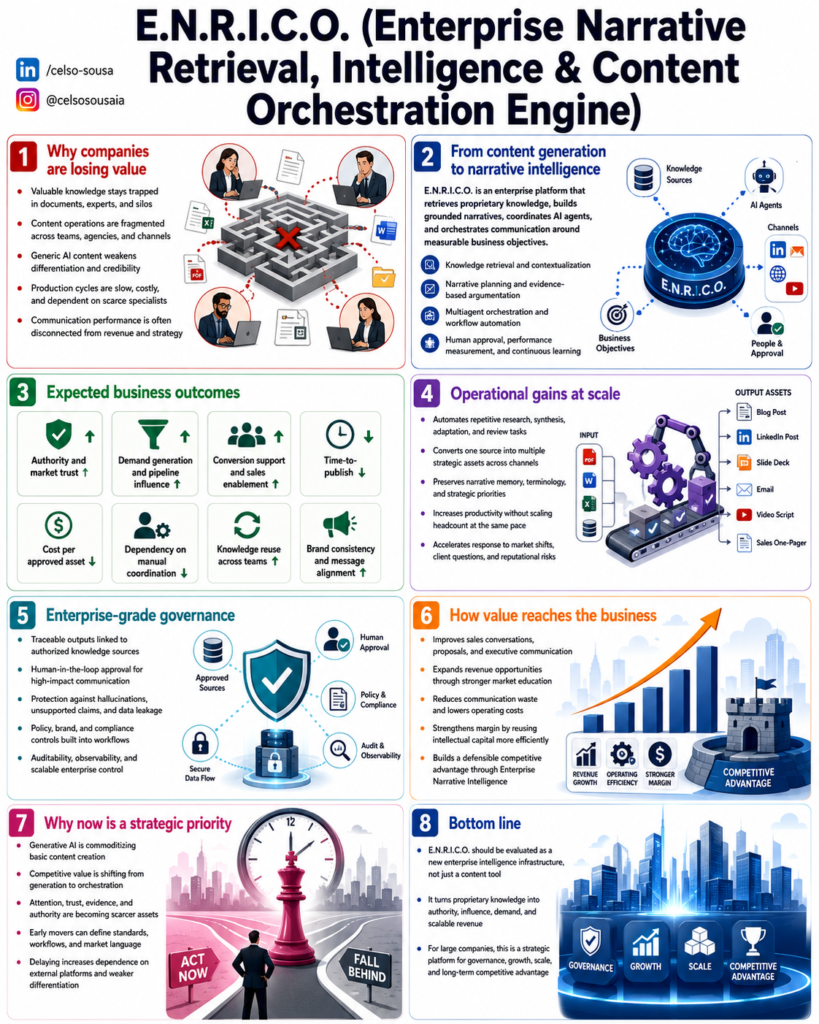
Most large enterprises possess valuable intellectual capital (research, technical expertise, methodologies, market knowledge, and executive experience) but struggle to convert it consistently into commercial influence. E.N.R.I.C.O. addresses this gap by transforming proprietary knowledge into governed, evidence-based narratives connected to measurable business objectives.
The platform operates beyond traditional content generation. Specialized AI agents coordinate knowledge retrieval, strategic analysis, argumentation, fact-checking, adaptation, approval, and multichannel distribution. This creates an enterprise operating system for narrative intelligence, reducing dependence on isolated experts, manual workflows, and external agencies.
Its impact can be managed through executive KPIs such as time-to-publish, cost per approved asset, workflow automation, knowledge reuse, factual accuracy, qualified reach, marketing-qualified leads, sales-qualified opportunities, pipeline influence, proposal acceptance, sales-cycle reduction, account expansion, and content-influenced revenue.
Strategically, E.N.R.I.C.O. enables companies to educate markets, strengthen executive authority, accelerate sales enablement, protect brand consistency, and respond faster to competitive or reputational events. Proprietary narrative memory, performance intelligence, specialized agents, governance systems, and enterprise integrations create a cumulative and defensible competitive moat.
The commercial model is highly scalable, combining Enterprise SaaS, dedicated licensing, private-cloud deployments, APIs, managed narrative intelligence, vertical industry editions, professional services, embedded intelligence, and an agent marketplace.
For enterprise leaders, E.N.R.I.C.O. represents a shift from producing more content to building a strategic infrastructure that converts knowledge into measurable influence, recurring revenue, and long-term market leadership.
G.A.B.R.I.E.L. (Generative Agent for Brand-Ready, Realistic Image Engineering & Lighting)
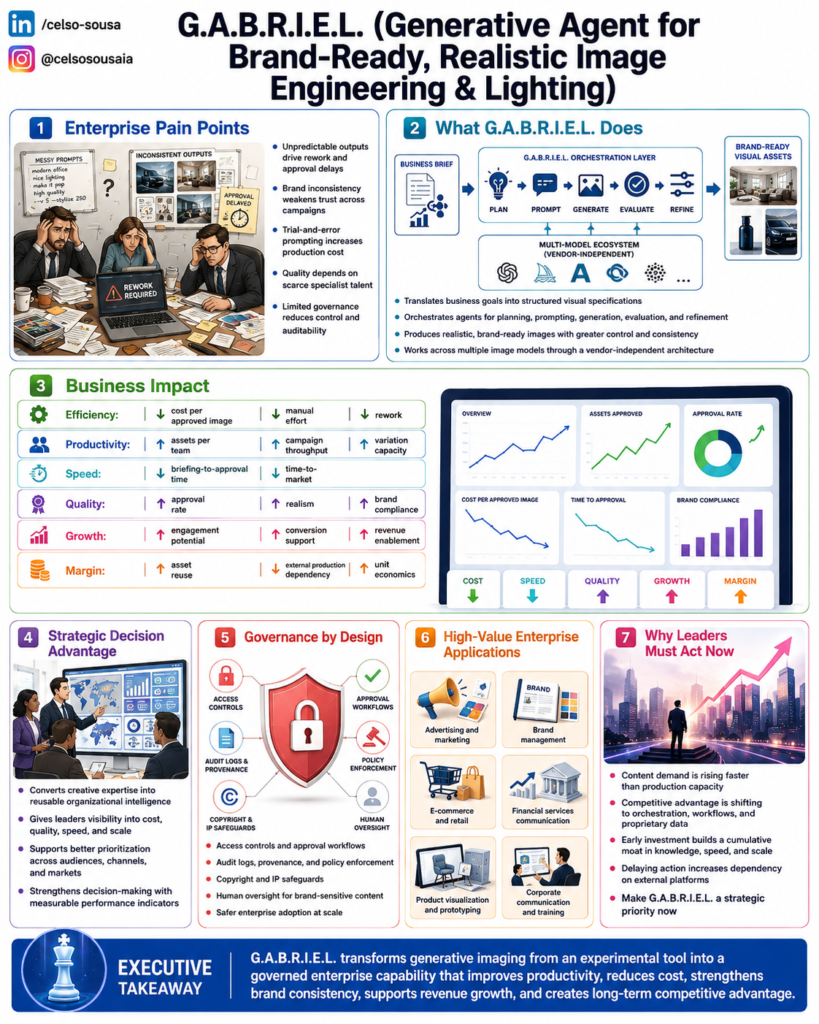
Generative imaging is becoming essential infrastructure for marketing, commerce, product development, and corporate communication. Yet most enterprises still operate through fragmented tools, unpredictable outputs, repeated prompt experimentation, and heavy dependence on specialized creative talent. G.A.B.R.I.E.L. transforms this process into a governed, measurable, and scalable visual production capability.
The platform uses specialized AI agents to translate business objectives into structured visual specifications, select the appropriate generation strategy, evaluate results, detect deviations, and execute controlled refinement cycles. This increases production speed, improves brand consistency, reduces rework, and enables creative teams to generate more assets without proportional headcount growth.
Its business impact can be measured through executive KPIs including production time per asset, iteration count, cost per approved image, approval rate, campaign throughput, asset reuse, brand compliance, click-through rate, conversion, gross margin, and revenue per customer.
Strategically, G.A.B.R.I.E.L. creates a defensible control layer above foundation models. Proprietary visual representations, evaluation benchmarks, specialized agents, accumulated feedback, enterprise integrations, and model-independent orchestration form a cumulative competitive moat.
The commercial opportunity supports multiple revenue streams: enterprise licensing, usage-based SaaS, APIs, white-label platforms, industry-specific solutions, professional services, technology partnerships, and internal applications across marketing, products, customer communication, and innovation.
For enterprise leaders, G.A.B.R.I.E.L. represents the transition from experimental image generation to industrial-scale visual intelligence: improving efficiency, accelerating time-to-market, protecting brand value, and creating recurring revenue.
K-Agents: the corporate operating system for governed and scalable Agentic AI
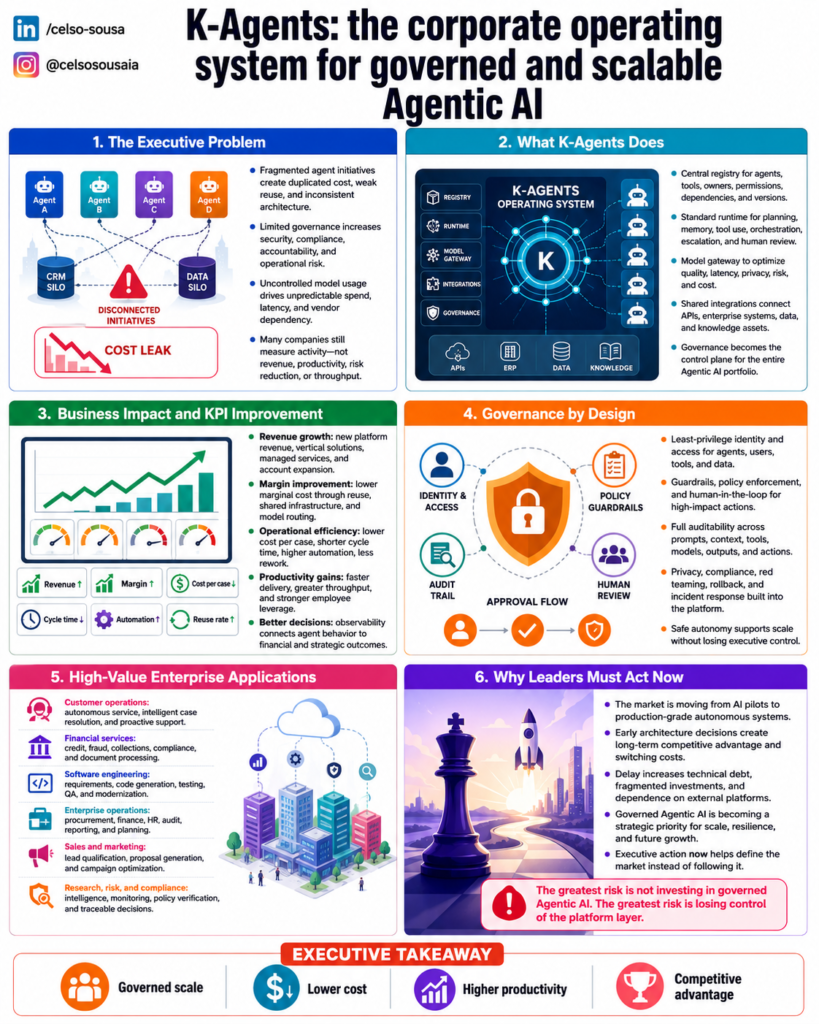
Enterprises are moving from AI assistants to autonomous agents capable of planning, making decisions, accessing corporate systems, and executing complex workflows. However, most organizations still lack the architecture, governance, observability, and financial controls required to scale these systems safely. K-Agents addresses this gap by providing a shared operating system for creating, governing, deploying, and monitoring enterprise agents.
The platform converts fragmented proofs of concept into reusable, production-ready assets. Standardized components, centralized integrations, model routing, AgentOps, lifecycle management, and governance-by-design reduce development time, lower marginal costs, improve reliability, and accelerate the transition from business opportunity to commercial deployment.
Executive KPIs include incremental revenue, cost per transaction, process cycle time, automation rate, throughput, employee productivity, component reuse, deployment frequency, agent success rate, latency, availability, cost per completed objective, policy adherence, security incidents, and return on invested capital.
Strategically, K-Agents creates a cumulative competitive moat through proprietary operational data, evaluation benchmarks, enterprise integrations, governance mechanisms, and scientific research. Every new agent and deployment strengthens the platform’s future economics.
Its business models extend beyond project-based AI services, including enterprise subscriptions, usage-based pricing, vertical agent suites, managed digital workforces, AgentOps services, governance-as-a-service, certified marketplaces, embedded infrastructure, and outcome-based contracts.
For enterprise leaders, K-Agents is not another AI initiative. It is strategic infrastructure for scaling autonomous intelligence with control, measurable ROI, and recurring revenue.
K-builder: corporate agentic software engineering platform for Kunumi
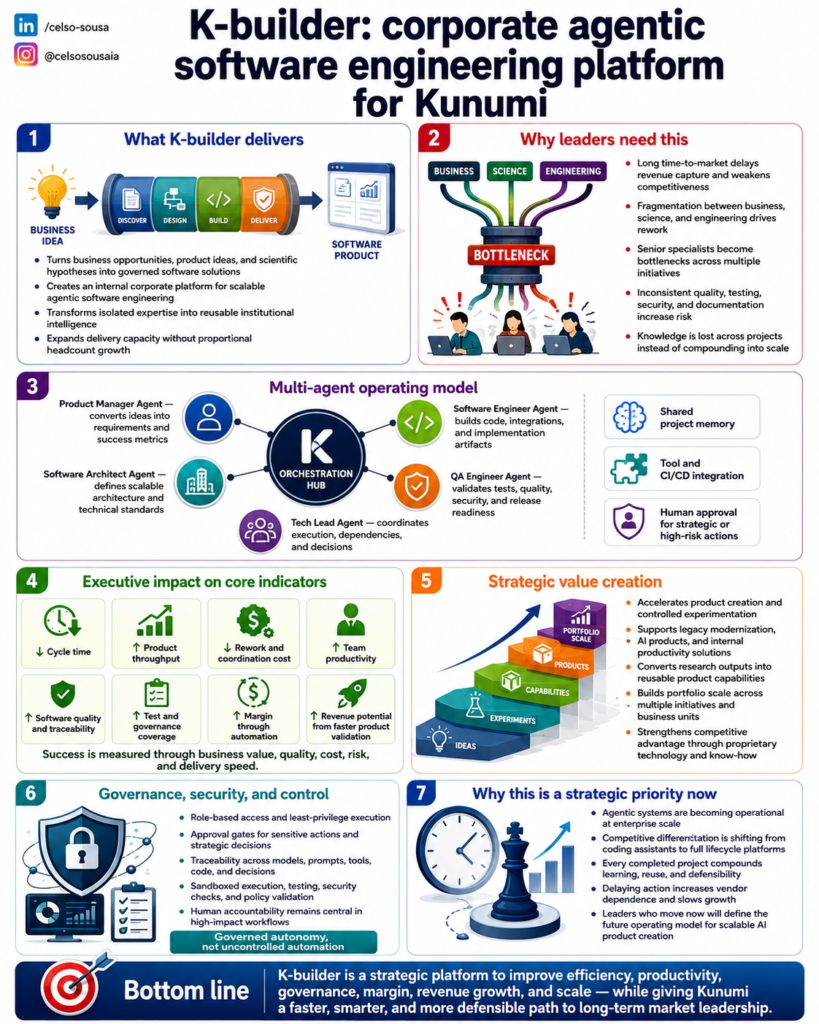
Software development remains a major constraint on enterprise innovation. Even companies with strong capital, data, and technical talent struggle with long delivery cycles, fragmented collaboration, scarce senior expertise, inconsistent quality, and limited reuse of organizational knowledge.
K-builder addresses this challenge through a corporate agentic software engineering platform that transforms business opportunities, scientific hypotheses, and product ideas into secure, scalable, and measurable software solutions. Specialized Product Manager, Software Architect, Tech Lead, Software Engineer, and QA Engineer agents coordinate the complete development lifecycle while preserving human control over strategy, risk, and investment decisions.
The platform’s impact can be measured through executive KPIs such as idea-to-production time, human effort per feature, parallel initiatives, defect density, rework, test coverage, cost per prototype, deployment frequency, automation rate, avoided cost, and economic value generated by accelerated products. Initial research targets include reducing selected cycle times by 30–60% and rework by 20–40%.
Strategically, K-builder creates a cumulative competitive moat through proprietary agent skills, reusable components, execution data, organizational memory, private benchmarks, governance controls, and domain-specific engineering knowledge.
Although designed as an internal platform, it enables new commercial value through faster AI-product incubation, legacy modernization, financial solutions, scientific platforms, regulatory applications, reusable intellectual property, and new digital ventures.
For enterprise leaders, K-builder is not simply a coding tool. It is an industrial capability for converting research, knowledge, and market opportunities into scalable products, lower development costs, and sustained competitive advantage.
K-Letter: agentic scientific communication and market intelligence platform
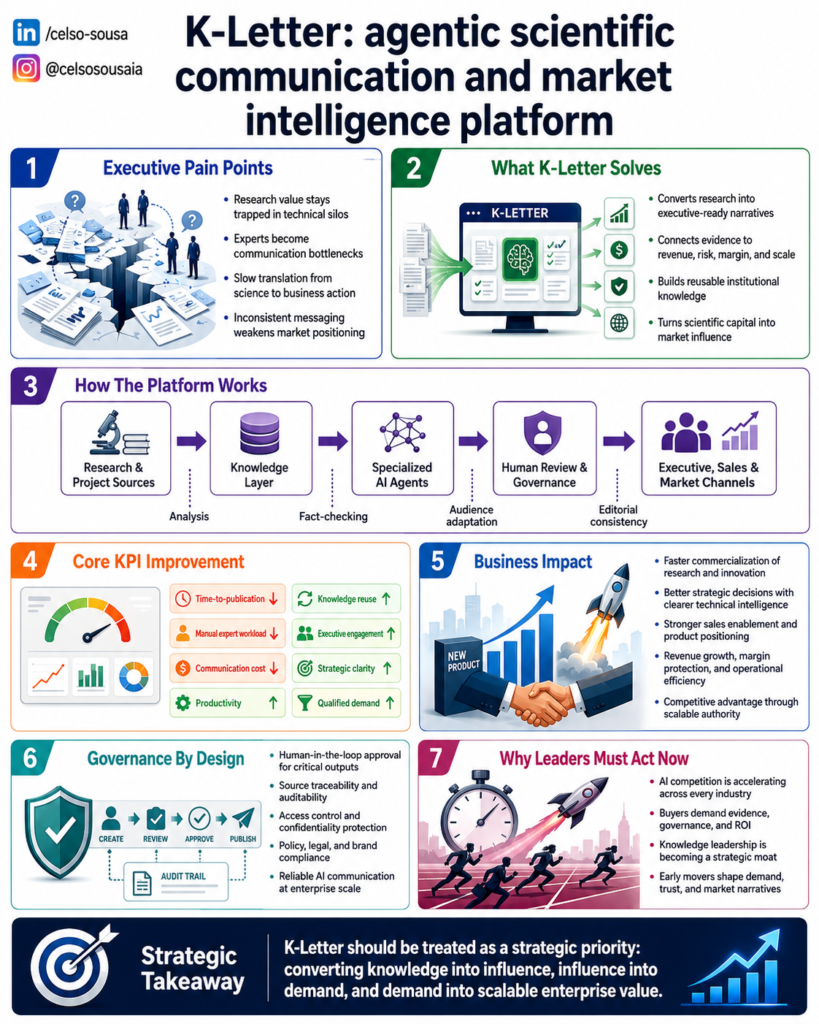
Scientific excellence creates enterprise value only when decision-makers can understand, trust, and apply it. K-Letter addresses this challenge by transforming research, experiments, and technical expertise into rigorous, accessible, and market-oriented communication through specialized AI agents.
The platform coordinates research, evidence validation, argumentation, audience adaptation, editorial review, and governance. This enables enterprises to reduce time-to-publication, increase expert productivity, preserve institutional knowledge, and reuse validated scientific assets across proposals, product launches, executive presentations, training, and market education.
Business impact is measured through executive KPIs—not content volume. Key indicators include influenced pipeline, qualified opportunities, conversion, sales-cycle duration, contract value, account expansion, expert hours per asset, publication throughput, factual accuracy, citation coverage, audience engagement, and revenue attribution.
Strategically, K-Letter strengthens technical authority, accelerates research commercialization, supports premium positioning, and helps organizations define how emerging technologies are understood before competitors control the market narrative. Proprietary knowledge graphs, datasets, evaluation benchmarks, agent workflows, institutional memory, and performance data create a cumulative competitive moat.
The platform also enables scalable business models, including enterprise software, managed scientific communication, market-intelligence services, executive thought-leadership programs, sales-enablement solutions, multilingual communication, and future external products.
For enterprise leaders, K-Letter represents strategic infrastructure for converting knowledge into influence, influence into qualified demand, and demand into scalable enterprise value.
KEO (Kunumi Engine Optimization): the agentic AI platform for search, answer, and generative discovery
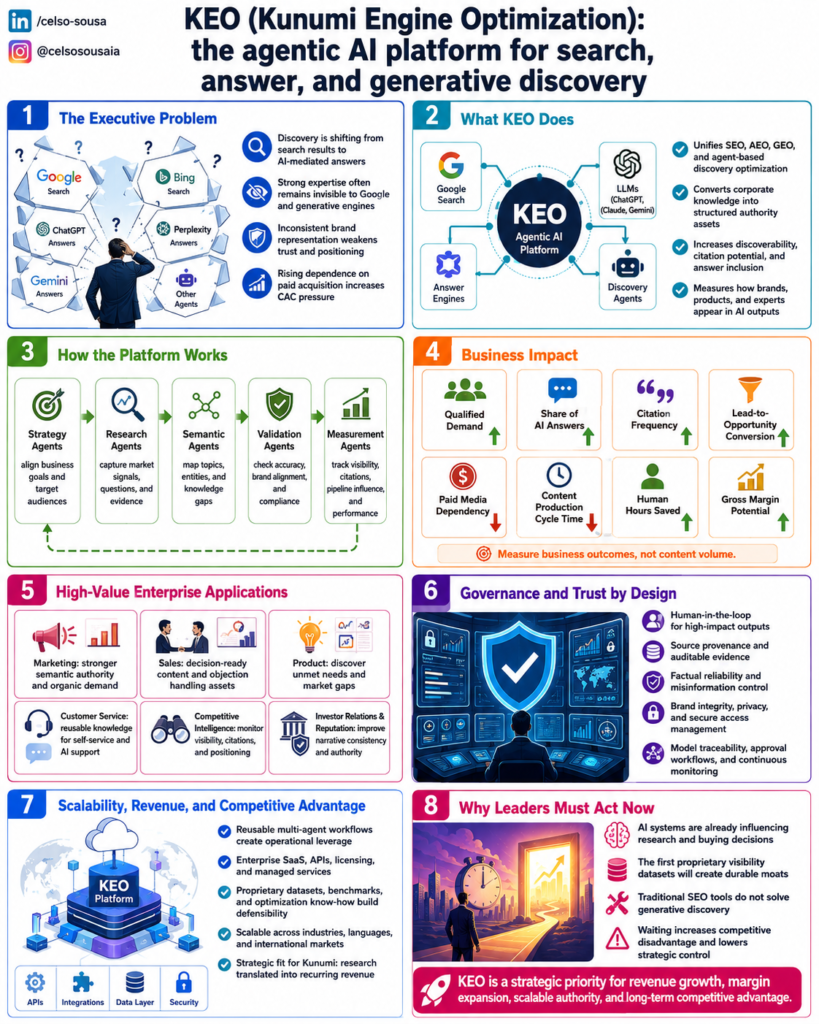
Digital discovery is shifting from traditional search results toward AI-generated answers, recommendations, and autonomous research. KEO addresses this transition by helping enterprises optimize how their knowledge, products, experts, and brands are discovered, interpreted, cited, and recommended across search engines, answer engines, and Large Language Models.
The platform combines SEO, Answer Engine Optimization, Generative Engine Optimization, semantic intelligence, and specialized AI agents within a unified enterprise capability. It transforms fragmented corporate knowledge into structured, evidence-based assets designed to strengthen authority, generate qualified demand, and reduce dependence on paid acquisition.
Executive KPIs include Share of Search, Share of AI Answers, citation frequency, source inclusion, qualified opportunities, influenced pipeline, conversion, win rate, sales-cycle duration, customer acquisition cost, organic acquisition contribution, annual recurring revenue, gross margin, and net revenue retention.
Strategically, KEO creates a defensible intelligence layer through proprietary visibility datasets, optimization benchmarks, specialized agents, enterprise integrations, multilingual capabilities, and continuous experimentation. Each deployment strengthens the platform’s ability to understand how AI systems retrieve, synthesize, and recommend information.
The business model supports Enterprise SaaS, dedicated licensing, specialized APIs, managed optimization services, vertical solutions, data and benchmark products, professional services, research partnerships, and performance-based revenue-sharing agreements.
For enterprise leaders, KEO represents the opportunity to convert corporate knowledge into measurable visibility, market influence, qualified demand, and sustainable revenue growth.
Paper2Anime: agentic multimodal platform for scientific storytelling and knowledge commercialization
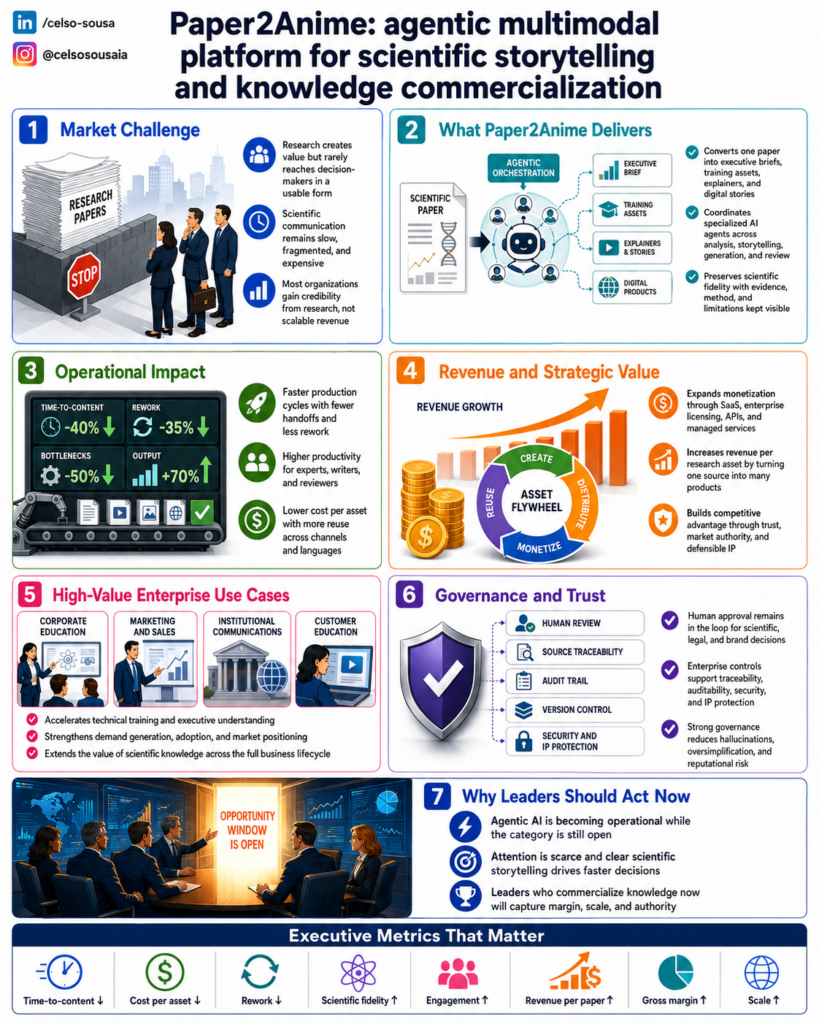
Organizations invest heavily in research, but much of that knowledge remains inaccessible to executives, employees, customers, and broader markets. Paper2Anime addresses this gap through an agentic multimodal platform that transforms complex scientific papers into engaging, traceable, and commercially scalable audiovisual narratives.
The platform coordinates specialized AI agents for scientific interpretation, knowledge extraction, narrative design, scriptwriting, visual direction, multimodal production, validation, and governance. One paper can become an animated episode, executive briefing, training module, localized campaign, interactive experience, or customer-education asset, without losing methodological context, limitations, or source traceability.
Its business impact can be managed through executive KPIs including production time, cost per finished minute, automation rate, expert-review hours, rework, scientific fidelity, comprehension gain, knowledge retention, completion rate, contract value, renewal, API consumption, gross margin, and revenue per scientific asset.
Strategically, Paper2Anime converts research expenditure into reusable intellectual property, institutional authority, educational products, and new customer relationships. Proprietary knowledge graphs, multimodal workflows, validation protocols, specialized datasets, and learning loops create a cumulative competitive moat.
The monetization architecture includes Enterprise SaaS, dedicated licensing, APIs, managed production, white-label platforms, corporate education programs, publisher partnerships, institutional subscriptions, original content studios, and intellectual-property licensing.
For enterprise leaders, Paper2Anime represents a new growth infrastructure: transforming scientific knowledge into attention, understanding, recurring revenue, and long-term market differentiation.